Half a million views for a resident doctor's advice: 'If you don't wear makeup, you don't need to remove it.' That's true, but is it enough?
A young doctor's viral advice is causing a heated split among women.
In recent days, a post by a resident doctor that has garnered nearly half a million views and tens of thousands of interactions has attracted the attention of the general public and the skincare community in particular. Specifically, the author of the post, Dr. Dai Thuy (Master's Degree - Dermatology Resident - Hanoi Medical University), made a strong statement:
"As a dermatologist resident, I advise you that if you don't wear makeup, you don't necessarily need to remove it!"

Advice that has gone viral in recent days comes from a Dermatology Resident.
Looking at the number of likes and shares reveals the considerable appeal of a topic that isn't new but remains useful when closely related to the daily lives and skincare routines of many women.
However, Dr. Dai Thuy's advice wasn't entirely well-received. In the comments section, the first thing you see are two opposing viewpoints: those who agree and those who disagree. Everyone is arguing based on their personal skincare experiences.

Two opposing viewpoints sparked a lively discussion.
Some mediators argue that while Dr. Thuy's advice is correct, it is incomplete, or more accurately, not specific enough:
"Although I'm not a dermatologist, I've worked with quite a few doctors and interacted with thousands of clients, and I myself have oily, acne-prone skin. I can confirm that doctors' advice is correct, but only for some people. Those with oily skin and living in environments with fine dust will understand just how essential makeup removal is."
"Many dermatologists on the threads give advice. But summarizing it in just a few sentences is very incomplete. For example, if you don't wear makeup or use sunscreen, then you don't need to use makeup remover, which is true. But in a humid tropical climate like Vietnam, even if you do nothing, using cleansing oil helps remove excess oil, fine dust, and balance the skin's moisture. Just saying things vaguely to get views is tiring."
Contacting Dr. Dai Thuy to better understand his perspective on the above situation, the doctor did not consider his opinion to be lacking in specificity because "principles are principles, but individualization still exists." The young doctor also denied creating content in this way to "open discussions" or "gain views" on Threads.

Many readers commented that this advice was correct but very general and not specific enough.
Expert's perspective: Don't turn makeup removal into a mandatory ritual.
To clarify this knowledge scientifically, dermatologist Dr. Nguyen Xuan Quang (Founder of MD Medical - Skin Therapy and Care) stated:
Makeup removal shouldn't become a mandatory ritual for all skin types. When cleansing, the deciding factor isn't the 'makeup remover' or 'face wash,' but rather the type of sunscreen used, the cleansing ability of the face wash, the amount applied, whether it's waterproof, whether multiple layers are needed, and the individual's skin type.
A study on the ability to remove sunscreen showed that non-waterproof sunscreen can be effectively removed with just facial cleanser, while waterproof sunscreen requires makeup remover for better cleansing.
Therefore, a more accurate way to say "if you don't wear makeup, you don't need to remove it" would be:
That's true in many cases, but not absolutely true for all. If someone uses sunscreen (non-waterproof), doesn't wear makeup, doesn't apply too many layers, and uses a suitable cleanser with good surfactants, then one cleansing step is usually enough. The surfactants in the cleanser are the ingredients that help remove oil, dirt, and leftover sunscreen from the skin.

Dermatologist Nguyen Xuan Quang (Founder of MD Medical - Skin Therapy and Care).
Below are detailed answers from Dr. Nguyen Xuan Quang to common questions:
1. If I don't wear makeup but use sunscreen, is facial cleanser alone enough?
Dr. Nguyen Xuan Quang: Yes, in most cases it is sufficient.
Makeup removers are primarily designed to dissolve foundation, lipstick, mascara, long-lasting products, and waterproof sunscreen. However, for those who only use regular sunscreen and no makeup, a gentle yet effective facial cleanser can perfectly handle the task. Current research shows that for non-waterproof sunscreen, facial cleansers are as effective as makeup removers and far surpass rinsing with water alone. But to argue from a dermatologist's perspective, one crucial point needs to be added:
What needs to be avoided is extreme thinking. You can't take the experience of someone who uses waterproof sunscreen, applies it 3-4 times a day, lives in a dusty and hot environment, and then apply it to someone who only applies one layer of sunscreen and works in an office. Those two situations are completely different in terms of how to cleanse the skin.

2. The combination of sunscreen and environmental dirt: Can facial cleanser compete?
Doctor Quang affirmed: It is still possible to clean the face completely normally if you use a suitable facial cleanser and wash it correctly.
Environmental dirt doesn't mean your skin needs extra cleansing steps. Skin isn't a pot that needs soaking, scrubbing, and scrubbing to get clean. In skincare, over-cleansing can actually damage the skin's protective barrier. The American Academy of Dermatology recommends gentle cleansing, avoiding scrubbing, and emphasizes that gentle washing removes dirt and dead skin cells without irritation. In other words, dirt and sunscreen don't necessarily need to be removed with makeup remover.
Things that require more attention are:
Is this facial cleanser suitable?
- Does that person wash their face for long enough?
- Do you thoroughly wash the edges of your face, the sides of your nose, and your jawline?
- Is that sunscreen waterproof and does it adhere well to the skin?

3. Why do many people report that after using facial cleanser without removing makeup or applying any cosmetics, they get breakouts after just a few days?
This section needs clarification: acne is a multifactorial condition, and it cannot be attributed solely to the cause of 'not removing makeup'. Dermatological literature describes acne as being related to multiple mechanisms such as increased sebum production, blockage of hair follicles, inflammatory reactions, skin microbiome, unsuitable products, touching habits, friction, internal hormones, and pre-existing skin conditions.
Therefore, when someone says, "I don't remove my makeup, I only wash my face with cleanser, and after a few days I get acne," scientifically speaking, that's just a coincidence at the time, not enough to conclude a cause-and-effect relationship.
Doctors offer five possible reasons for acne, instead of just blaming the cleansing routine:
- Skin that is already prone to clogging pores.
- The sunscreen is too thick, causing clogged pores and not suitable for my skin type.
- The facial cleanser is unsuitable or doesn't clean properly.
- Stress, sleep disorders, hormonal fluctuations, irregular eating habits.
- Over-cleansing can irritate the skin, disrupt the skin barrier, and lead to inflammatory rashes.
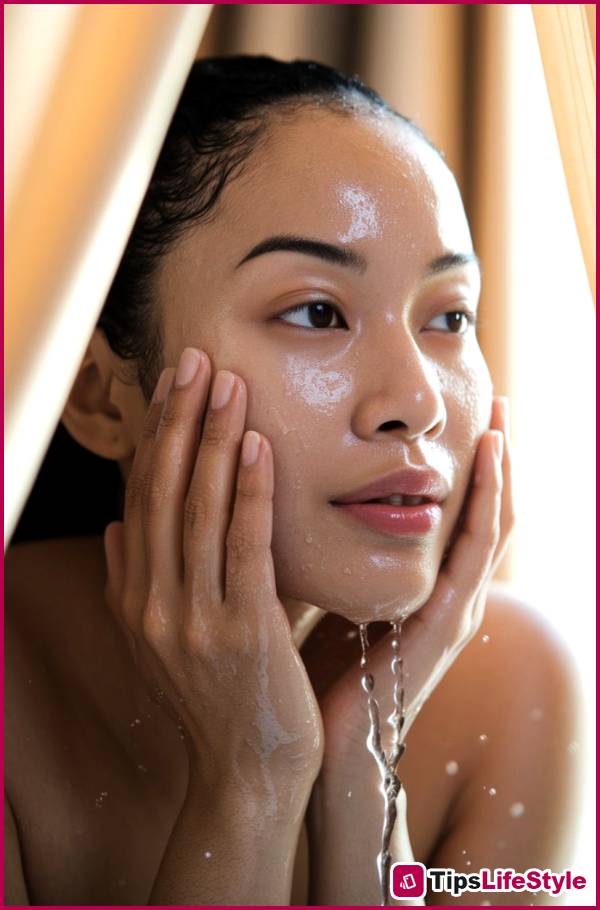
Expert conclusion: Makeup remover is a tool, not the ultimate truth.
- If you don't wear makeup and only use sunscreen, in many cases, a facial cleanser is sufficient.
- If you're only using sunscreen and dealing with environmental dirt, a facial cleanser can still clean well, provided the product is suitable and the sunscreen isn't too water-resistant.
- Makeup removal isn't a mandatory daily routine for all skin types; it's a tool to use when needed.
- The idea that "not removing makeup leads to acne" is an overly simplistic conclusion for a complex condition. Acne has multiple causes; you can't blame everything on skipping the makeup removal step.
In short:
"We shouldn't over-glorify makeup remover. It's not meant to prove the need for a more thorough skincare routine, but rather to help cleanse the skin when applying products that are difficult to remove, such as makeup or waterproof sunscreen. If you only use regular sunscreen and no makeup, a suitable facial cleanser is sufficient. The claim that breakouts occur after a few days without makeup removal is unfounded without assessing the skin type, sunscreen type, cleanser type, internal factors, and a host of other elements. Dermatology doesn't work based on one-sided assumptions."
Internet photo, provided by the subject.